A successfully launched product and a disastrous “blackout” at trade shows in Las Vegas will depend on just one invisible element: dedicated event WiFi connectivity. As we move forward to CES 2026 and the busy schedule of conventions at the Las Vegas Convention Center (LVCC) and Mandalay Bay Convention Center, the need for bandwidth is no longer simply about accessing emails. Today, it is all about powering the “Big Three” of modern trade show exhibits: live AI presentations, 8K media streaming, and seamless fintech.
The “Big Three” is no longer enough to enjoy these at CES 2026. Besides CES, these are some of the big Las Vegas trade show activities of 2026, pushing their data needs to the extremities of the city’s internet capacity:
- NAB Show (April 2026) — A total of 100,000 media and television industry representatives simultaneously transmitting live video, requiring ridiculous upload speeds.
- Informatica World & AI World (May & October 2026) — These will be trade show exhibitions of the “AI Ready” categories, where each booth needs to connect to a cloud-enabled neural net.
- Money 20/20 in (October 2026) — Low latency and secure connections are simply imperative for real-time financial transactions.
“Venue WiFi” is no longer sufficient to provide each trade show company its own “dedicated” path. The reason is simple — venue WiFi connectivity is shared.
The Hidden Connectivity Crisis Facing Las Vegas Trade Shows
The most dangerous threat to a Las Vegas exhibitor isn’t a total internet outage — it’s the “Digital Ghost.” This occurs when a device shows full signal bars, but data throughput is near zero. In the cavernous halls of the Sands Expo or the LVCC, the sheer volume of “noise” from thousands of Bluetooth beacons, wearables, and rogue hotspots creates a signal-to-noise ratio that renders standard hardware useless.
For a company demoing a smart-home ecosystem or a medical IoT device, a Digital Ghost can make a revolutionary product look like a prototype failure. Professional event WiFi providers solve this through Directional Antenna Arrays, which focus the “hearing” of the network specifically on your booth’s footprint, effectively tuning out the digital chatter of the surrounding 50 booths.
Venue WiFi — The Interference Crisis
A trade show as massive as the LVCC will find hundreds of booths using their own consumer-grade WiFi routers. That’s co-channel interference (CCI) at its best. Scores of routers operating simultaneously in this vast hall simply “step on each other’s” signals, creating problems such as:
- Packet Loss — No data is received, resulting in the “Spinning Wheels of Death” effect during product demonstrations.
- Jitters — Disconnected internet audio and video disrupt video conferencing and live streaming.
- Contention — Your trade show internet is suddenly interrupted because the next booth begins streaming its HD product launch.
Industry secret: As reported by WiFit.net, total device density at trade show activities today exceeds 10 devices per trade show visitor. A total of 130,000 visitors results in 1.3 million active wireless signals in play at the trade show. You are no longer simply managing visitors — you’re managing signals.
Strategic Trade Show WiFi — The Answer
The “big logjam” in trade show venue WiFi will soon become passé for the serious exhibitor. The serious trade show player will soon acquire its own PRIVATE PORTABLE INTERNET OPERATION KITs.
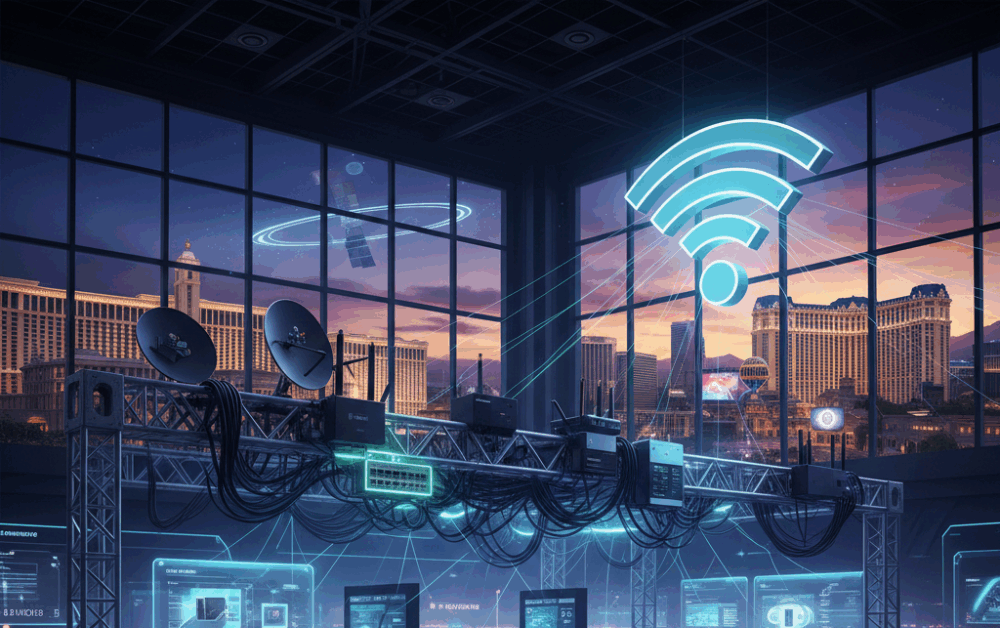
These provide duplicate transmissions of essential data packets across multiple layers of 5G internet, in addition to satellite internet. In the instance that one internet connection experiences temporary congestion, the other connections immediately fill the gap, nullifying the possibility of a demo freezing at the exhibit booth.
While many small- to mid-sized exhibitors view the cost of dedicated WiFi as an extra line item, veteran marketers view it as insurance for their ROI. The average cost of a 20×20 booth at a premier show like CES or NAB can easily exceed $50,000 when factoring in floor space, drayage, and staffing. If a salesperson spends 15 minutes of every hour troubleshooting a cloud-based slide deck or waiting for a lead-gen form to sync, the company is effectively wasting 25% of its investment.
By utilizing a managed Las Vegas event WiFi service provider like WiFit, technical friction is removed, allowing the team to focus on conversion rather than connectivity. In the context of a million-dollar brand activation, the cost of a private, bonded 5G network is a fraction of a percent of the total budget — yet it is the single point of failure for the entire exhibit.
Strategic Planning, or the “Logistics” of Internet Access
The key mistake, or blunder, of the exhibit booth is treating internet access as a “utility” or “service,” rather than a “strategy.”
A good internet strategy is always driven by failover, whereby, if the booth’s primary internet source or a nearby internet tower goes down, the exhibit booth immediately switches to a backup internet source via L-band satellite or a secondary internet connection — without anyone even realizing the transition.
Previewing the Future of CES in 2026
The year 2026 marks a turning point in how “temporary” internet is delivered, moving away from a single source toward a Triple-Redundant Architecture. We are now seeing the integration of Low Earth Orbit (LEO) satellite technology, such as Starlink, paired with multi-carrier 5G bonding.
In outdoor Las Vegas venues — such as the massive parking lot activations at the LVCC West Hall — satellite provides a “clean” skyward path that avoids terrestrial cellular congestion. However, satellites can struggle with latency spikes. To solve this, providers use intelligent load balancing, sending light, high-priority data (such as credit card authorizations) over low-latency 5G links, while heavy data (such as software updates or video loops) is offloaded to satellite.
This hybrid approach ensures that even if a nearby cell tower is overwhelmed by 100,000 people posting to social media, the booth remains an island of high-speed stability.
Security: The Silent Requirement for 2026 Events
Beyond speed, security is the “silent” requirement for 2026 events. Major tech conferences in Las Vegas are prime targets for packet sniffing and data interception. When an exhibitor uses shared venue WiFi, they are essentially operating on a public LAN with thousands of strangers.
For companies showcasing unreleased software or proprietary AI models, this represents a massive liability. Dedicated event WiFi allows for the creation of an Air-Gapped Private Network. By using a hardware-based firewall and a private gateway, exhibitors can ensure their demo devices never touch the public “airwaves” of the convention center.
This level of encryption is no longer optional for fintech, defense-tech, or healthcare exhibitors; it is a foundational requirement for protecting intellectual property on the world’s most public stage