Nolan Cottingham spent six years watching customers order burgers through a drive-through window five minutes from Taiwan Semiconductor Manufacturing Company’s Phoenix construction site. Today, the 23-year-old monitors semiconductor production alongside engineers from Taiwan, participating in cross-cultural exchanges that define TSMC Arizona’s workplace culture.
His transformation reflects broader changes rippling through north Phoenix, where TSMC’s $165 billion investment has created pathways for service workers, displaced laborers, and recent graduates to enter advanced manufacturing. The apprenticeship program that facilitated Cottingham’s transition embodies both the collaborative ethos TSMC has imported from Taiwan and the economic opportunities spreading through Arizona communities.
TSMC Arizona’s apprenticeship structure emphasizes collective learning over isolated training. Process technician apprentices attend classes together, sharing discoveries and troubleshooting challenges through group chat channels they established independently. Cottingham describes an environment where 44 process technician apprentices—ranging from 19 to approximately 40 years old—created informal support networks within their first week.
John, Nolan Cottingham’s assigned mentor and a senior process technician, exemplifies the teaching philosophy permeating TSMC’s training approach. Rather than providing direct answers, he guides apprentices toward independent discovery. After three and a half months of constant shadowing, Cottingham transitioned to semi-autonomous work while maintaining regular consultation with his mentor.
The mentorship extends beyond formal pairings. Cottingham regularly assists two fellow apprentices working in his department’s defect review team, creating feedback loops where newer workers learn from those slightly ahead in the program.
Cultural Exchange Through Daily Interaction
Food has emerged as an unexpected catalyst for workplace integration at TSMC Arizona. Cottingham maintains a drawer filled with Taiwanese cookies, reciprocating when colleagues share traditional snacks. He orders donuts for the 5:30 a.m. shift start and occasionally brings in In-N-Out burgers—a gesture that connects his previous workplace to his current position.
“One of our engineers, he sometimes cooks, and he’ll bring over whatever food he cooked and have us try it,” Cottingham noted. These exchanges facilitate communication across cultural boundaries, with Cottingham adopting nonverbal acknowledgments common among Taiwanese colleagues while his counterparts explore American foods.
Morning routines reflect the interconnected nature of semiconductor manufacturing. Cottingham reports that he receives approximately 30 Teams messages before 6 a.m. from 10 departments, each requesting assistance with experiments, problem-solving, or production adjustments. This constant communication stream requires navigating what he calls “figuring out how to communicate properly without being either too short or too confusing.”
Economic Transformation for Workers and Region
Cottingham’s economic trajectory mirrors projections for the broader Phoenix workforce. Five months after beginning the apprenticeship, he purchased a townhouse—transitioning from rental payments to property ownership at age 23. His story aligns with TSMC’s stated goal of creating 6,000 direct manufacturing jobs paying wages often exceeding $100,000 annually.
The apprenticeship eliminated Cottingham’s consideration of $80,000 in flight school debt or uncertain student loans for other career paths. “You kind of get stuck in that overwhelming decision area where you have too many paths, where you kind of just freeze and you don’t pick any,” he reflected on his pre-TSMC uncertainty.
Educational Infrastructure Development
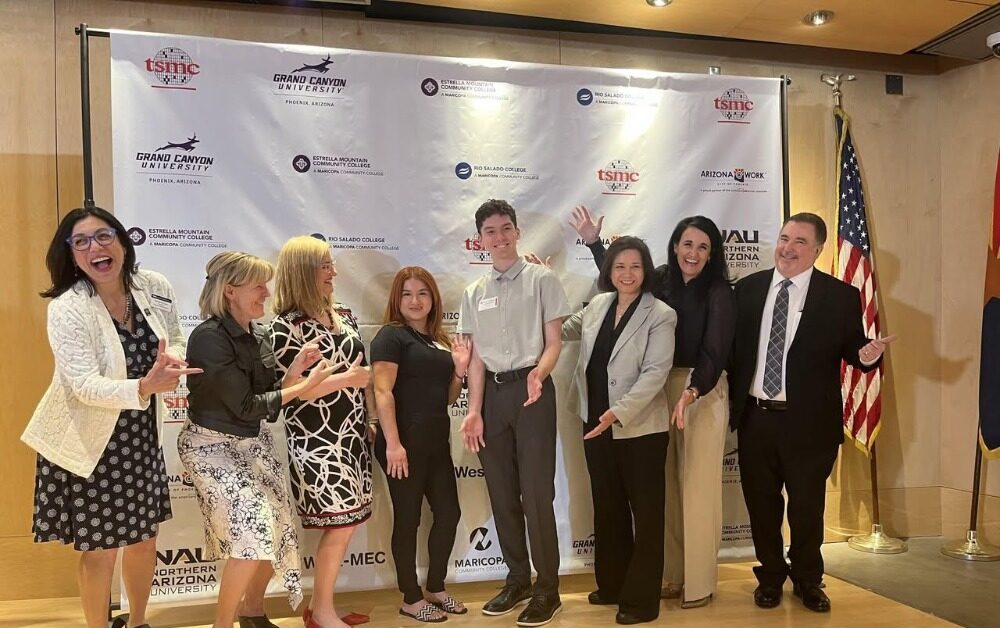
TSMC’s workforce needs have catalyzed educational partnerships across Arizona. The company invested $5 million in apprenticeship programs through collaborations with Maricopa Community Colleges, Arizona State University, Northern Arizona University, Grand Canyon University, and Western Maricopa Education Center.
Cottingham’s cohort represents the early implementation of these partnerships. Process technicians attend courses at partner institutions while working full-time, earning stackable credentials over 18 to 24 months. The curriculum combines TSMC’s Taiwan-based training methodologies with U.S. apprenticeship standards, creating a boost for semiconductor industry jobs in America.
Phoenix has received designation as a federal Workforce Hub under CHIPS Act initiatives, with the city’s workforce board becoming the first to sponsor semiconductor industry registered apprenticeships. Maricopa Community Colleges received $1.7 million from the NSTC Workforce Partners Alliance to expand semiconductor technician training and launch accelerated programs.
Cottingham characterizes his work as “detective work” among approximately 2,000 process steps in semiconductor manufacturing. Daily challenges require collaboration across departments, with process technicians serving as connectors between specialized engineering teams.
“If somebody has a problem, you’re like, ‘Oh, I want to fix it,’” he explained. “Just doing those things when you get to figure something out on your own, and then you get to say, ‘I did it’, that’s rewarding.”
This problem-solving orientation extends throughout the apprentice cohort. Despite varied backgrounds—from teenagers to middle-aged career changers—participants share what Cottingham describes as intrinsic motivation to understand complex systems. School sessions provide theoretical frameworks that illuminate practical work: “Every time I come back, then I’m getting more information and it’s helping me come to better conclusions.”
Workforce Pipeline Sustainability
TSMC plans to recruit 130 new apprentices and trainees in 2025, expanding beyond the pilot program’s focus on facilities technicians. Equipment technicians, process technicians, and manufacturing technician specialists will receive training through expanded educational partnerships.
The apprenticeship addresses workforce challenges identified by Axios Phoenix, which reported that TSMC’s expansion requires “capturing workers at every entry point: recent high school graduates, mid-career laborers displaced by automation, food-service workers who never considered a job in the tech industry.”
Arizona Governor Katie Hobbs has positioned the apprenticeship expansion as evidence of state-industry synchronization: “With strong partners like TSMC, Arizona has been a leader in synchronizing our workforce efforts and investing in training that meets private sector needs.”
TSMC’s promotion structure provides defined advancement pathways. Cottingham anticipates five to eight years before qualifying for senior technician status, with opportunities to transition between technology nodes as the company expands its Phoenix facilities.
“I want to be able to say, I worked on N4, N2, A16,” he explained, referencing semiconductor process technologies. Construction of adjacent facilities creates visible reminders of future opportunities—two fabs under development mirror the expansion Cottingham witnessed during training in Taiwan.
TSMC Arizona faces documented challenges scaling its workforce model. Cultural adaptation has required adjustments from both American and Taiwanese employees. Cottingham acknowledged periods where work becomes “stressful,” and teams must “lock down” to meet production demands.
Yet his assessment after five months remains unequivocal: “I’m grateful for it and it feels rewarding to do.” The combination of economic stability, intellectual challenge, and collaborative environment has transformed what began as proximity-based curiosity into career commitment.
Phoenix Mayor Kate Gallego frames TSMC’s workforce development as transformational: “Creating thousands of high-wage jobs and fueling economic growth for generations.” Cottingham’s experience suggests these projections rest on tangible foundations—mentorship structures that transfer knowledge, cultural exchanges that build workplace cohesion, and educational partnerships that convert service workers into semiconductor technicians.
His morning commute past In-N-Out toward TSMC’s cleanrooms traces a path increasingly available to Phoenix residents. Each apprentice following similar routes contributes to what economic development officials call an emerging “Silicon Desert,” where semiconductor manufacturing creates cascading opportunities for workers previously confined to service-sector limitations.